
An initial report by Stephan Kimmerle, delegate from Seattle
Over 1,200 delegates convened at the biannual DSA Convention. The Democratic Socialists of America’s highest decision-making body represents more than 80,000 members – up from 64,000 in October of last year, with many joining after Trump’s second-term victory and Zohran Mamdani’s win in the Democratic Party’s New York City mayoral primary. The size, energy, and new found confidence at the Convention were all indications of a new chapter opening up for DSA. A wave of radicalization is bubbling up across the US reflecting a surge of resistance against Trump, the genocide in Palestine, and a new cycle of socialist electoral campaigns. The left wing of these movements is finding an organized expression in DSA. All signs point to DSA being on track to experience a new surge, likely surpassing 100,000 members in the coming months.
The outcome of the Convention positions the organization to develop into a much more visible socialist force on a national level. However, it will require deliberate efforts not only to align with the sentiments of activists but also to help them turn toward winning over the labor movement, social movements, and broader segments of the working class to break with the Democratic Party, advocate for Palestinian liberation, and connect our movements to the struggle against capitalism and imperialism.
Delegates were optimistic about our capacity to grow DSA in both numbers and strength, and to build toward a mass working-class party. The hallways, breakout discussions, and informal meetings were filled with excitement about Zohran Mamdani’s success, strategizing debates about how to combat Trump and build the Palestine solidarity movement, and intense exchanges on how to strengthen ties with the labor movement and other social movements.
Unfortunately the convention agenda seemed to be stuck in a business-as-usual routine. Rather than a focus on the biggest issues and debates facing DSA and the working class, the resolutions and amendments on the agenda, especially on the first day, concentrated on the nitty-gritty aspects of DSA’s internal organizing and structures. While this lack of focus on politics was not ideal, the Convention made its way through the agenda in a more experienced fashion than previous conventions. This represented a maturation of the organization, allowing us to address political differences in a calmer atmosphere compared to earlier conventions.
The lack of discussions on climate change, socialist feminism, and the relatively limited exchange on strategies for fighting racism (beyond the issue of immigration) were notable weaknesses at the Convention.
The Convention marked a new shift to the left in DSA’s development. This was fueled by fury at the genocide in Gaza and a new confidence after the success of Zohran Mamdani. It resulted in the election of a new more left-wing NPC, presenting exciting opportunities for DSA to evolve into a more visible national force. This requires unifying campaigns, efforts toward political independence from the Democratic Party, and a strong process of educational discussions aimed at developing a new political platform for DSA and moving the membership toward a more developed understanding of socialism as a break with capitalism.
However, the dynamics of the Convention and the preceding months also highlight the dangers of DSA being more rooted in online activist debate culture rather than in working-class communities or the traditions of mass struggle. The new left-wing DSA leadership is at risk of bending DSA’s politics and profile to reflect the outlook (and pressures) of radical activists who often lack the necessary politics and orientation to successfully carry out mass work within the working class.
Co-Chair and NPC Elections
Since 2023, DSA has had two national co-chairs who are paid to work full-time for the organization. They are also full members of the National Political Committee (NPC), the highest decision-making body between Conventions. After changes to the constitution at this Convention, the two co-chairs of YDSA have full voting rights on the NPC. (They previously had only half a vote each.) Since the Convention agreed to expand the size of the NPC from 17 to 27 members, the Convention elected 23 at-large members of the NPC as well as 2 co-chairs.
Over the past two years, Ashik Siddique from Groundwork and Megan Romer from Red Star have represented the organization as DSA co-chairs both publicly and internally. Both ran for re-election, facing a challenge from Alex Pellitteri of Bread & Roses.
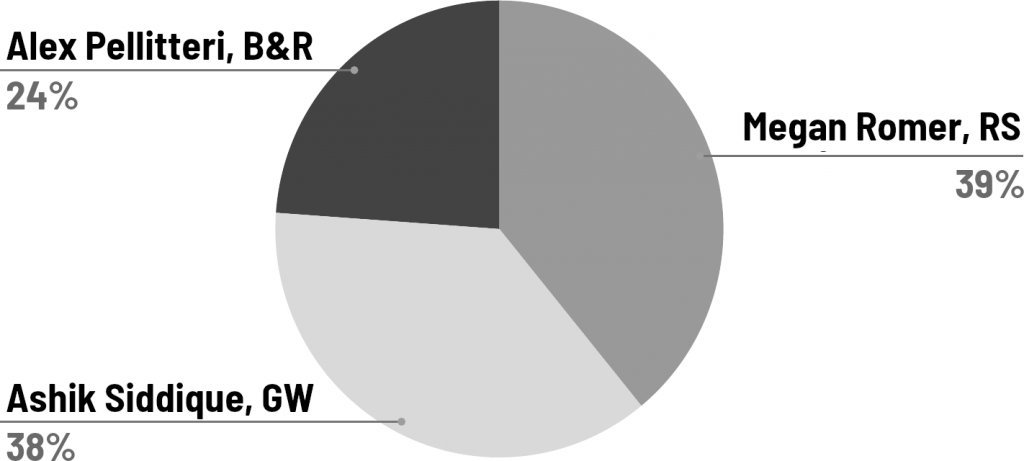
Megan Romer got the most first-ranked votes (483), followed closely by Ashik Siddique (458 votes). Alex Pellitteri came third (295 votes), thereby failing to win a co-chair position. Romer and Siddique will be the co-chairs for the next two years.
The various elections have resulted in a new NPC, which is presented here with caucus alignments in a simplified “moderate-to-left” list:
- SMC, Christian A
- SMC, Clayton R
- SMC, Jeremy C
- SMC, Katie S
- Groundwork, Cara T
- Groundwork, Eleanor B
- Groundwork, Frances G
- Groundwork, Kareem E
- Groundwork, Ashik S (Co-Chair)
- Carnation, Abdullah F
- B&R, Cerena E
- B&R, Ella T
- B&R, Hayley B
- R&R, Daniel S-C (YDSA Co-Chair)
- R&R, Sarah M
- MUG, Amy W
- MUG, Cliff C
- MUG, Sid CW
- Independent (politically sympathetic to Red Star), Sara A (YDSA Co-Chair)
- Red Star, Hazel W
- Red Star, John L
- Red Star, Megan R (Co-Chair)
- SoR, Ahmed H
- SoR, Andrew T
- SoR, Francesca M
- SoR, Luisa M
- LSC, David J
In this simplified presentation, the majority of the NPC shifts slightly to the left. On the 2023-25 NPC, Bread & Roses members were the swing vote between the right and left wings. Now the Reform & Revolution NPC members may find themselves in that role. The next NPC would, based on this right-to-left perspective, have majorities either with SMC, Groundwork, B&R, and R&R, or with R&R, MUG, Red Star, SoR, and LSC, potentially placing R&R in a deciding position.
Upon reviewing the votes and developments leading up to the Convention, there are compelling reasons to analyze DSA and its NPC in a three-pole framework. Rather than merely distinguishing between the moderate wing and the left, I believe it is more useful to consider:
- A moderate wing that emphasizes mass work, aims for DSA to resonate with a broader working-class audience, and adopts an opportunistic approach toward DSA’s elected officials, rather than moving toward the “dirty break” from the Democratic Party accepting the “dirty stay”, and labor leaders. This wing includes Groundwork and SMC.
- A far-left wing that reflects the sentiments of left activists within the Palestine movement and advocates for a campist “anti-imperialism,” willing to align with even ultra-religious and conservative forces like Hamas and the Houthis as long as they are opposing the US empire. This includes Red Star and Springs of Revolution. (The danger of self-marginalizing approaches of the far-left of DSA were visible in the last term of the NPC, especially on international questions.)
- A Marxist center that seeks to merge an orientation towards the mass of working-class people with a strategy aimed at building an independent socialist party, while promoting class struggle and socialist ideas within labor and social movements. The center includes Bread & Roses.
Over the past two years, MUG has frequently aligned with Red Star, and the majority of R&R has shifted more in this same direction, away from the earlier politics of the caucus (although R&R also broke with others on the left on certain Convention votes). In the lead-up to the Convention, R&R has been reluctant to collaborate with the moderate forces within DSA, which could present significant challenges for the future of the organization.
At other times, however, MUG and R&R have emphasized, at least in rhetoric, the importance of principled socialist mass work. If this approach from MUG and R&R prevails, we could see:
- A more engaging and dynamic leadership within DSA, finally moving toward holding elected officials accountable through robust public engagement that seeks to educate DSA members and the left-wing base of electeds about the need for principled socialist politics
- Significant progress toward DSA functioning like a party and actively working toward a “dirty break” from the Democratic Party
- A revival of a more vigorous rank-and-file strategy in the labor movement focused on building from the bottom up, employing a class-struggle approach, and engaging in reform caucuses with a socialist strategy
- National mass campaigns by DSA that honor the big-tent nature of the organization while uniting activists in a collective effort to fight for our shared goals
- An inclusive process to develop a new program for DSA that facilitates a full and democratic discussion on key issues, such as our stance toward the capitalist state (For example, how should a Mayor Mamdani interact with the NYPD? How does this align with our overarching goals?)
Based on this analysis, the challenge for revolutionary Marxists is to build a Marxist center of DSA that can lead in the direction of principled mass work and the national visibility of DSA in broader movements against Trump, in labor, and in social movements. Comrades in B&R, MUG, and R&R should urge their three caucuses to politically lead this fight, charting a path independent of opportunism and sectarianism.
Rashida Tlaib: “A Weapon Is a Weapon”
The topic of the war on Palestine dominated discussions at the Convention.
Keynote speaker Congressmember Rashida Tlaib addressed the Convention with a powerful and emotional message against the war. She linked the votes in Congress that fund the genocide with the lack of funding for reforms such as Medicare for All and clean water. Tlaib condemned “the establishment of both parties” for their role in financing the genocide, pointing out that both the Republicans and Democrats are funded by billionaires.
In a clear contrast and apparent criticism of Alexandria Ocasio-Cortez, Tlaib stated, “A weapon is a weapon.” AOC had voted in July in favor of an amendment for the US to fund Israel’s Iron Dome, justifying it by saying there is a difference between supplying “defensive weapons” and “offensive weapons” to Israel. In contrast, Tlaib and Ilhan Omar correctly voted against the amendment. (AOC later voted against the underlying military funding bill as a whole.)
Tlaib spoke out against “capitalistic systems of exploitation” and emphasized that “the working masses are hungry for revolutionary change… That’s why DSA is so important. We are able to honestly and truthfully diagnose the problems facing working-class Americans.” She urged DSA – referring to the organization as “we” – to use language that is understandable to working-class people, those who corporate Democrats and Republicans have abandoned, in order to explain “what democratic socialism can mean for their lives.” Tlaib urged DSA to orient our work toward the broad mass of the working class and bring more people of color into our organization by convincing them of democratic socialist ideas – very necessary tasks for DSA.
In an otherwise internally focused Convention with many bureaucratic-sounding resolutions and amendments, Tlaib’s comments inspired the delegates who roared with huge applause and loud chants of “Free Palestine!”
While Tlaib’s sharp criticism of corporate Democrats was very welcome, her votes to elect Hakeem Jeffries as leader of the House Democrats are not consistent with this message. Tlaib’s outstanding role in the opposition to the slaughter in Gaza unfortunately stands in contrast to her votes to expand NATO and fund the US involvement in the war in Ukraine.
Tlaib’s speech highlighted the role of Democratic Socialists as crucial in the struggle for a better world. This excellent point needs to be matched by her and other DSA candidates running for office with a prominent socialist profile and by actively using their campaigns to promote DSA and build independent political organizations of working people.
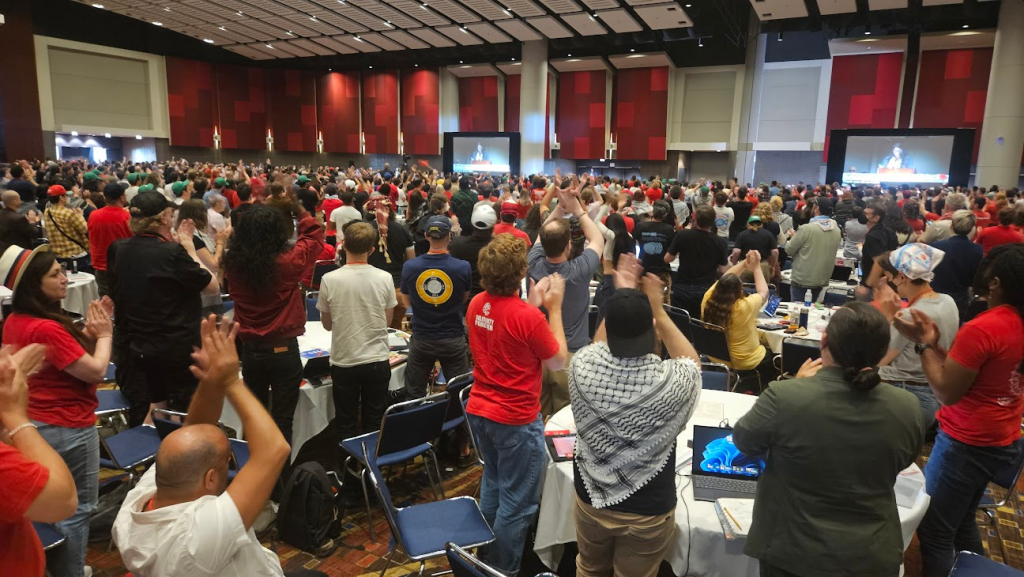
Photo: Stephan Kimmerle
Internationalism
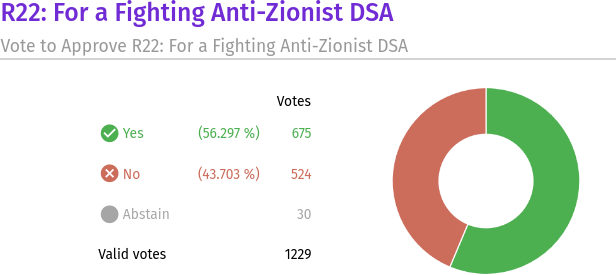
The discussion on Palestine featured in the deliberations on anti-Zionism. This was a continuation of the discussions of the 2023 Convention where a similar resolution had not found a majority. This time the Convention passed Resolution 22, For A Fighting Anti-Zionist DSA, that mandates that candidates are ineligible for a DSA endorsement – both nationally and locally – if they fail to meet certain standards for supporting BDS and the Palestinian struggle. The resolution also enables DSA to expel members for certain actions or beliefs that are deemed contrary to DSA’s position on Palestine. The resolution included as binding the support of another resolution previously passed by the NPC, which demands “that all of DSAʼs endorsed candidates hold true to the following basic commitments: Fully and publicly support the Boycott, Divestment and Sanctions (BDS) movement; […]”.
This would not have allowed DSA to endorse Bernie Sanders – including the building of an organization clearly criticizing Sanders for his shortcomings on the question of Zionism. If implemented, Resolution 22 would not allow DSA to critically endorse, for example, Shawn Fein if he were to run for president in 2028. Fain often has weak positions on international issues (such as his position on tariffs), and Bernie often has weak international stances as well. This new policy will not strengthen but weaken the anti-Zionist and socialist impact of DSA on the left-wing moving base of such politicians.
However, it will be up to the new NPC to interpret Resolution 22. The authors of the resolution themselves emphasized that DSA should remain flexible in its implementation of the resolution.
Amendment 22-1, aimed to remove language about the expulsion of members who act in support of Zionism and automatic exclusion of endorsements of candidates failing to meet the defined standards. Although the amendment was unsuccessful, it still garnered 46% support.
The unamended resolution passed with 56% to 44%.
Resolution 1 to position DSA in favor of a single, secular state in Palestine – and also make support for this position a prerequisite for receiving DSA endorsements – failed, with 30% in favor and 70% opposed. The vote appeared to reflect a broad mixture of opposition to the resolution, with many delegates disagreeing with how the resolution framed its support for a single, secular state.
The broader ongoing debate in DSA on international issues between supporters of a “campist” position and an “anti-campist” position was expressed around an amendment to the International Committee’s consensus resolution. “Campism” is the view that the enemies of Western imperialism are our allies, regardless of their politics or how they treat “their own” working class.
The summary of the anti-campist amendment read:
DSA should build relationships with a diverse array of left parties and movements in other countries, including those in and out of government. DSA should learn from and stand in solidarity with movements in the Global South fighting for democracy and socialism against all governments that engage in the repression of democratic rights and side with capital over workers. Finally, DSA should re-affirm that the NPC is the highest decision-making body of the organization between Conventions.
The clarification about the NPC being the highest decision-making body was added because of previous conflicts between the elected leadership of DSA – the NPC – and the leadership of the International Committee.
This amendment failed with 43% in favor and 56% against.
Electoral Work
The theme of this year’s Convention was “Rebirth and Beyond: Reflecting on a decade of DSA’s growth and preparing for a decade of party building.” However, the road ahead – how to build toward a mass workers’ party – was highly contested.
The Convention’s focus was less on the party question itself and more on how DSA-endorsed candidates will campaign and perform their duties in office. Given the frustration of many DSA members about a lack of accountability of elected officials, this year’s consensus resolution presented by DSA’s National Electoral Committee focused on running candidates who represent DSA and come from the ranks of DSA. The Convention voted in favor of this resolution, demanding that our candidates “openly and proudly identify with DSA and Socialism, including by: Expressly encouraging people to join DSA” and “identifying publicly as a ‘Socialist’ or ‘Democratic Socialist.’” It urges chapters to demand that candidates show “a commitment to building a socialist slate and political independence” from the Democratic Party.
The wish to move away from endorsements that leave us without much influence on elected officials also was reflected in the resolution arguing against “paper endorsements” in general. The resolution also conflates endorsing non-DSA candidates with “paper endorsements.”
While the resolution correctly takes steps toward building our strength to run politically stronger DSA candidates, the opposition to “paper endorsements” threatens to cut off DSA from engaging in campaigns where socialists can benefit by aligning themselves with radical left-wing candidates who are not part of DSA. DSA’s endorsement of Bernie Sanders for president in 2020 was the largest campaign in DSA history (far from a “paper endorsement”), yet Sanders was not a DSA member and did not represent the politics of DSA. DSA was absolutely correct to endorse Sanders, despite his political weaknesses, as his campaigns represented, on balance, a major step forward and an opportunity to build support for socialism.
DSA’s mistake was how it uncritically supported Bernie and failed to openly and clearly challenge Bernie’s political weaknesses, not that it endorsed and helped build his campaign.
Some movers of the motion still claimed that DSA would retain its flexibility to endorse such candidates.
With the 2028 presidential election coming up and the call for a mass strike on May 1, 2028, the Convention debated an important Resolution 33, which stated:
DSA should aspire to build a broad left-labor coalition, composed of labor unions and other mass organizations, which can draft a platform; recruit candidates for federal, state, and local office for the 2026 and 2028 elections; and draft a socialist candidate for the 2028 presidential election. In order to gain real traction and look more like Bernie Sanders’ presidential campaigns than past third-party campaigns, DSA should back a viable candidate in the Democratic presidential primary, such as a nationally known elected official, labor leader, or public figure, who will primarily publicly identify with and promote DSA, socialism, and/or a left-labor coalition rather than the Democratic Party. DSA will advocate for such a coalition to endorse independent and nonpartisan down-ballot candidates as well as candidates running in Democratic primaries.
Resolution 33 passed by 59% to 41%.
Resolution 20” put forward by Socialist Majority presented a bold vision of running labor candidates in the coming elections. However, the boldness was paired with an effort to tone down the socialist profile of DSA’s candidates. It appeared to redirect the desire for cadre candidates of DSA and building political independence from the Democratic Party toward a much muddier approach. Amendment 20-1 supported the underlying resolution’s positive initiative to run labor candidates and proposed to link these campaigns to bold, democratic socialist politics, building toward political independence from the Democratic Party. Although the amendment was strongly opposed by comrades from Socialist Majority, the amendment passed with 73% in favor.
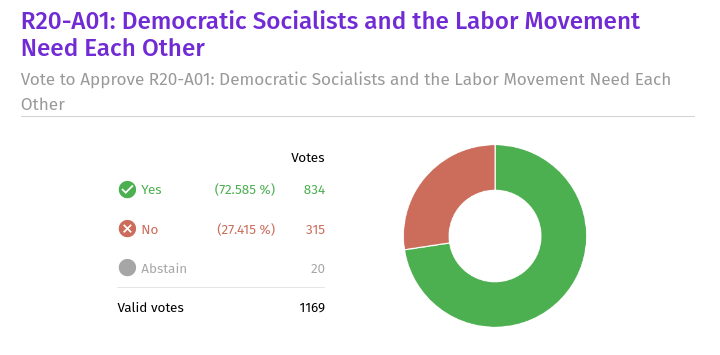
The underlying base Resolution 20 was passed, as amended, with overwhelming support. (The tech for tabulating this vote was down at the time, so we don’t have precise numbers.)
Labor
Despite the importance of DSA’s work in the labor movement, the Convention had limited discussion on this topic. The National Labor Commission presented the. R&R and MUG authors moved Amendment 10-1 which aimed to clarify the political role of socialists in the labor movement, directing the NLC to “lead and coordinate DSA members in the labor movement to organize against the Democratic Party, against the Republican Party and the authoritarian right wing, and for socialist politics.” This amendment also aimed to raise the bar for democratic bargaining processes from just demanding a “right of members to vote on all collective bargaining agreements” to the “right of members to have democratic control of collective bargaining and the strategy around it.” The amendment narrowly lost with 48% in favor, 52% against.
Program
Bread & Roses proposed Resolution 34 to establish a commission to draft a platform for DSA and, in the meantime, accept the “Workers Deserve More” program as our current platform. Resolution 34 was adopted with 76% in favor. Amendment 34-1 to adopt a more radical program narrowly lost with 44% of the vote, but it revealed a lot of interest in the debate about DSA’s platform, with the list of speakers wildly exceeding the time available.
One Member, One Vote?
The Groundwork caucus proposed Constitution & Bylaw Amendment 2 to change how we elect DSA’s national leadership. This resolution would have us elect the NPC through an online vote of all members, a position supported by the Socialist Majority Caucus. Groundwork submitted a similar proposal to determine national endorsements of candidates via “one member, one vote” (1M1V) polls. But they presented this proposal as a resolution rather than a bylaw amendment, and it was therefore ruled out of order.
Both !M1V proposals sparked a lot of debate leading up to the Convention. While these proposals were presented as a means to enhance democracy, opponents argued that it would actually result in less deliberation among elected delegates, who come together to debate, persuade their comrades of their positions, and foster a more developed and informed decision-making process.
Behind the technicalities of this question – of which system would be better for making decisions – lies the unacknowledged reality that the activists (and therefore the delegates) in DSA are clearly to the left of the vast majority of members. Groundwork and Socialist Majority, the two moderate caucuses supporting “1M1V,” aimed to leverage this to push the organization, relatively speaking, to the right. Unfortunately, the left did not use its majority on the NPC for the last two years to take significant initiatives to activate and educate the broad membership (through dynamic campaigns and meaningful debate that engage the broad membership on key questions).
1M1V was rejected by 60% (736 votes) of the delegates, while 40% (487) voted for it.
Democracy Commission
After growing from a pre-2016 membership of around 6,000 to now over 80,000 members across more than 200 chapters, there is broad agreement that DSA’s democratic structures need to be updated. The 2023 Convention established a Democracy Commission to research and develop a CB-1: A Comprehensive Structural Reform Proposal in advance of the 2025 Convention. The Red Star caucus objected to the expansion of the NPC from 17 (16 full members + 2 representatives from YDSA, each with half a vote) to 27 members, arguing that this increase would make the national leadership less functional. The Red Star caucus also objected to the reelection of the Democracy Commission, claiming it would be undemocratic for the Convention to reelect them as such a long-standing body.
After some heated debates, the Commission’s package of structural reforms were accepted by a clear majority (over 80%).
By accepting the proposals of the Democracy Commission, the Convention also repealed the infamous ban on members of “democratic centralist” organizations. This remnant of DSA’s past as a much more moderate force on the left, which was fearful of revolutionary influences, has finally been removed.
Independent of the commission’s proposals, delegates enhanced “big tent” democracy by requiring that all elections for delegates to the national convention be conducted using the Single Transferable Vote (STV) system. This decision to approve Bylaw Amendment 4 will prevent a majority within a chapter from monopolizing all delegate positions, which can occur with other voting methods. This will ensure proportional representation of diverse perspectives and viewpoints within each delegation. The Convention’s strong vote for STV, with 63% in favor and 47% against, was a defeat for the moderate caucuses who fought to maintain the status quo.
Budget Crisis
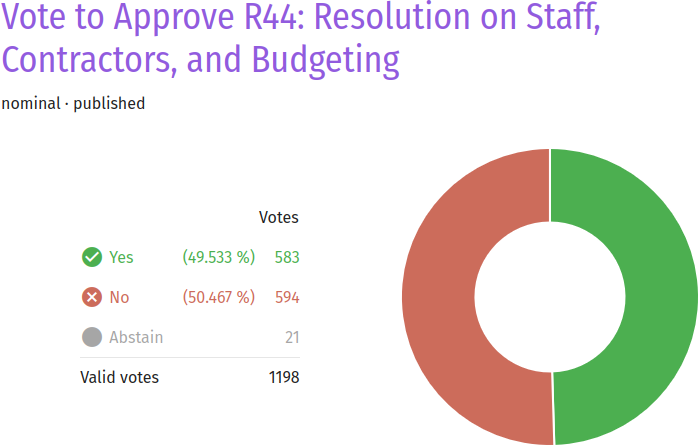
In response to the 2024 budget crisis, comrades from the left of DSA prioritized a resolution on the agenda aimed at preventing future financial deficits by establishing technical rules. Resolution 44 outlined that staff expenditures should be capped at 40% of dues-based income at the time of hiring. If income were to decline, a hiring freeze would automatically be triggered if staff expenditures reached 50% or more.
This rigid approach to the finances of a socialist organization mirrored discussions from a year ago under the leadership of a left NPC majority, when, amid the Palestine solidarity movement, DSA turned inward to discuss staff reductions, initially without even asking the membership to donate to try to overcome the deficit.
Resolution 44 was barely rejected by a margin of 49.5% to 50.5% of the delegates.
DSA Staff and Democracy
Up until now, DSA staff members have not allowed to be part of caucuses. Tasked with representing the general organization, they were also prohibited from expressing their opinions in an organized manner outside of their hours on the clock. However, following a resolution put forward by Bread & Roses, this policy was changed by the Convention. They argued that this change would promote more transparency (by ending the practice of encouraging staff to hide their opinions), increase accountability, and grant the staff who are DSA members their democratic rights. This resolution was adopted.
The passage of this resolution was part of a larger positive change in the relationships between DSA staff and our elected leadership. Previously the NPC had limited control over the national organization, with much power concentrated in the hands of a non-elected national director. During the 2023-25 NPC, following the departure of the national director Maria Svart, the elected co-chairs took on responsibilities that were traditionally held by the national director. This shift enhanced the democratic functioning of the DSA. In light of this change, the newly elected 2025 NPC was not presented with a Non-Disclosure Agreement at its inaugural meeting, which had been standard practice in previous years.
Cross-Organization Political Exchange
On Saturday afternoon, a cross-organization and international discussion offered a valuable view into the rich connections DSA has built. Representatives from labor unions, especially left locals and reform caucuses, shared their views about building toward a workers’ party and collaborating with DSA. Among them were members of the CTU, Caucus of Rank-and-file Electrical Workers (CREW), Essential Workers for Democracy, a rank-and-file caucus in the National Association of Letter Carriers, and Railroad Workers United. Social movements were represented by the Debt Collective, the Sunrise Movement, BDS, and the Palestinian Youth Movement. International guests from Brazil included the Socialism and Liberty Party (PSOL) – with its left represented by Left Socialist Movement (MES) and its more moderate wing by its president – as well as the Workers Party (PT). Guests also came from Belgium (Workers Party), La France Insoumise, Morena from Mexico, Democracia Socialista from Puerto Rico, the Democratic Socialists from Japan. Outgoing NPC member (and Bread & Roses member) Laura Wadlin deserves credit for playing a central role in organizing this valuable exchange.
On the last day of the Convention, we heard greetings from Cuba and from Jeremy Corbyn on behalf of YourParty.uk. Both were received with loud and vigorous applause.

On a personal note: I came to this convention with a new book, A User’s Guide to DSA: 5 Debates That Define the Democratic Socialists (edited by Philip Locker, Brandon Madsen, and myself). We brought 130 copies to the Convention, where the book appeared for the first time, and it sold out! If you didn’t get it yet, you can order it at labor-power.org.
| If you are a DSA member, you can find discussions and corrections related to this article on the DSA Discussion Board, where I have also posted it. |
On the DSA Discussion Board, David Duhalde commented on this report and offered some corrections. With his permission, I include his comment here:
I want to thank Stephan Kimmerle for such an in-depth and long report so shortly after the convention. Even just today, I shared it with a comrade at work eager to hear about the convention results.
My only two comments are one of praise and one of historical perspective.
First, I think Kimmerle’s use of “moderates” for the caucuses of SMC and Groundwork is a lot more accurate than the use of the binary left/right divide that others have used. I used a similar spectrum in my recent Socialist Party-DSA comparative history piece “The Long Reroute”. We are all leftists, but of different stripes. Moderate, radical, revolutionary, etc. are more helpful descriptions.
Second, I do want to offer a bit of historic additional [information] about the democratic centralist rule that was removed from the DSA constitution. Information that I doubt would have changed anyone’s vote, much less the result, but reflects why I feel a way left-right being unhelpful at times to understand the dynamics in DSA – today and yesterday. Kimmerle wrote:
By accepting the proposals of the Democracy Commission, the Convention also lifted the infamous ban on the members of “democratic centralist” organizations. This remnant of DSA’s past as a much more moderate force on the left, which was fearful of revolutionary influences, has finally been removed.
I feel this statement misses some historical nuance, while being true to a point. As people may know, DSA resulted from a merger of Democratic Socialist Organizing Committee (DSOC), which was pretty anti-Communist (big C), and the New American Movement (NAM), which was much more sympathetic to revolutionary socialism, included self-described Communist states. (My history of U.S. democratic-socialist solidarity with Chile covers this more in depth, but the two groups have very different approaches and understandings of what caused Popular Unity to fail and how to support Chileans. Includes quotes from current NPC members Luisa and Christian, too.)
DSOC did not have any anti-democratic centralist rule because, logically, there wasn’t any concern of Communists joining. If I remember correctly, in one of Harrington’s memoirs, he discussed the opposite problem occurring for either DSOC or DSA (I forget which one) of them having to de-charter a Miami chapter because it was overtaken by anti-Castro forces not in step with the organization’s more progressive vision.
It was NAM actually that had the democratic-centralist rule because their members experience with entryism in other formations. I spoke to a few NAM veterans before writing to this and they said, like with DSA, the rule was actually never used or enforced. In fact, only one person was removed from NAM and it was for behavioral reasons. I am including a photo of that from their by-laws. Happy to share the PDF of the by-laws with anyone, especially fellow history buffs.
